The Heat Tax Hiding in Plain Sight
By Jay Pzier
It’s hot outside; it’s even hotter inside as temperatures climb all morning inside the manufacturing plant. It’s only a matter of time before employees working on the shop floor start to wilt as the heat drains their focus and energy.
This is how heat takes a toll on employees, often before anyone recognizes it as a safety issue. There is no general-ledger account called “excessive heat,” but it’s a price many organizations pay nonetheless. Before the effects of heat show up in a spreadsheet, they manifest themselves in human behavior. By the last half of the workday, employees may not be working optimally. Some go home exhausted. Others leave at the first opportunity for a job in a better environment. That is the heat tax. It shows up in lost working time and in the cost of keeping people in a difficult environment. It is impossible to attach a universal dollar figure to the loss of heat-related productivity. Workplaces differ, as do people. But that doesn’t mean the cost is imaginary, even if the cost is easy to ignore.
Employees are only trying to protect themselves. But if someone is seeking relief from the heat, that person is obviously not working.
Many companies have learned to live with hot working conditions. In fact, “That’s just the way it’s been” is a surprisingly durable capital-planning philosophy. Employees have always found a way to get through the shift. Over time, that history can make excessive heat seem like an unavoidable part of the job.
We need to update that perspective because employers have an enlightened self-interest in the health and well-being of their employees. When an employee reports they were so exhausted when they got home that they just collapsed from fatigue, the last half of their workday was probably not very productive. As an employer, I want my employees to enjoy their evenings and then return ready to work the next day.
WHEN HEAT STARTS TAKING TIME
The heat tax may be difficult to calculate as one figure, but parts of it can be measured. Heat does not have to send someone to the hospital before it begins costing a business time. The National Institute for Occupational Safety and Health recommends limiting time in the heat and allowing workers to recover in a cool area. Its sample schedule for heavy work at 95 degrees Fahrenheit calls for 15 minutes of rest each hour. At 100 degrees, work and recovery split the hour evenly. The actual schedule depends on humidity, direct sun and the work being performed.
64°F
Optimal workplace temperature for lowest work-time loss
603
Full shifts analyzed across countries and industries
16M+
Seconds of video matched to conditions
A 2025 field study led by Leonidas Ioannou examined 603 shifts across several countries and industries. After matching more than 16 million seconds of video with conditions during each shift, the researchers found that work-time loss was lowest around 64 degrees Fahrenheit and rose as temperatures moved in either direction.
Heat may also affect judgment. For instance, a forklift operator laboring in extreme heat who is miserably uncomfortable may make a poor decision.
Berkley Findings
Researchers from the University of California, Berkeley’s Center for the Built Environment and the University of Sydney conducted a six-week field study where they monitored 30 people working four weekly 10-hour shifts in steel plants. The employees continued their normal manufacturing work, including mechanical assembly, electrical work, welding, machining and grinding. The fans operated for half of each day, either during the morning or the afternoon, allowing the researchers to compare fan-on and fan-off conditions.
The clearest result was the difference in how workers experienced their environment. Based on their thermal-sensation responses, the researchers calculated an average subjective cooling effect of 5.7 degrees Celsius, or a little more than 10 degrees Fahrenheit. Responses about perceived exertion produced an estimated effect of 5 degrees Celsius, or 9 degrees Fahrenheit.
“Fans cool people. They do not cool rooms.”
Subjective does not mean imaginary. The number describes what the worker experienced, not a drop in room temperature. If the air is 90 degrees, the fan does not turn the building into an 80-degree space. Under the conditions in the study, the workers experienced a cooling effect comparable to lowering the air temperature by roughly 10 degrees.
100%
Of exit-survey respondents said fans at work were important
79%
Felt more effective when the fans were running
-10°F
Average subjective cooling effect reported
Every respondent to the exit survey said having fans at work was important. Seventy-nine percent felt more effective when the fans were running. Sixty percent said they felt much more effective, while 19% felt a little more effective. At comparable temperatures, workers were also less likely to say the heat made it difficult to work effectively when the fans were running.
That is evidence of perceived effectiveness, not measured productivity. The study took place at NovelAire, which makes complex custom equipment. The researchers could not compare the number of units made with the fans on against the number made with them off.
The Berkeley researchers also found physiological evidence consistent with the benefits of air movement. With the fans running, workers’ average sweat rate was about 29 grams per hour lower during May and June and about 38 grams per hour lower during August mornings. The researchers said that at those temperatures, the fans increased convective cooling, which reduced the amount of sweat needed to cool the body. During the hotter August afternoons, workers produced about the same amount of sweat with or without the fans, but the researchers concluded that the added air movement probably helped more of that sweat evaporate and carry heat away from the body. Fan use did not worsen the heart-rate or sublingual-temperature measures tracked during the study.
Studying people in an operating factory gets complicated. Employees performed different jobs at different levels of physical effort. Their clothing and activity were not controlled. The workers’ comments help explain what the survey results meant during an ordinary day. They described the fan-off days as tiring and said they left work drained and dehydrated. One worker reported that without the fans, all he wanted to do was go home and crawl into bed. When the fans were running, he could have a normal evening.
COOLING PEOPLE IS NOT A PLACEBO
For years, the fan industry leaned on the phrase “perceived cooling effect.” We had a large customer interpret the phrase to mean that fan-based cooling was a placebo. The customer mistakenly concluded that fans didn’t actually cool people and could therefore become dangerous above 85 degrees.
The way a ceiling fan works is that air movement across your body increases heat transfer through the temperature difference and through the evaporation of moisture off your skin. Per physics, under most conditions, air moving across your skin is actually removing heat from your body. Anyone who has ever stood in a breeze at the beach understands it.
“Sweat on the floor does you no good because cooling the floor does not make you any cooler.”
Sweat makes the mechanism visible. In hot, stagnant conditions, the body may sweat faster than the moisture can evaporate. Clothes become soaked and sweat rolls off the skin, landing on the floor. With suitable air movement, however, more of that moisture can evaporate from the skin and do the job the body produced it to do.
THE ANSWER DEPENDS ON THE WORKER
Whether a fan helps depends on what the person is doing and wearing. The conditions in the building matter too. Age is a factor. Your ability to sweat changes as you get older. Your ability to reject heat changes as well, and it doesn’t get better.
Acclimatization is another big factor. When I worked as a mail carrier during college, I spent summer days walking outdoors in Iowa. During the first week or two, I wondered whether I could do it. I drank gallons of water and sweated through everything I wore. After a couple of weeks, I was better able to tolerate the heat. It still wasn’t good, but my body had adjusted. That is why heat-injury plans call for employers to watch new and returning workers closely during their first couple of weeks. (NIOSH recommends gradually increasing the time workers spend in hot conditions over seven to 14 days.)
A fan usually cools the body in two ways: It moves heat away from the skin and helps sweat evaporate. When the air becomes hotter than the skin, the first effect reverses and the moving air begins transferring heat to the body. A fan can still help if the additional evaporation carries away more heat than the hot air adds. Whether that happens depends largely on the temperature and humidity.
Where that balance tips is not a uniformly agreed-upon point. Some U.S. government guidance puts the limit much lower than current research does. Studies cited by the Berkeley researchers found that fans reduced physiological heat strain among people at rest at temperatures between 39 and 43 degrees Celsius. The result depended on the humidity, as well as the age and health of the people involved. Ultra-dry conditions create another problem. Below roughly 20% relative humidity, sweat may already evaporate without additional air movement, allowing heat from the air to become the larger effect.
How much a fan will help depends on what the person is doing, what they are wearing and the surrounding environmental conditions. The Fans & Heat module in Berkeley’s CBE Thermal Comfort Tool lets users enter the conditions, the work being performed and the clothing being worn to determine whether additional air movement is likely to help.
Sometimes ventilation needs to come first. We looked at a tortilla factory where ovens released heat and steam into a building with very little fresh air. Temperatures inside the facility reached 105 to 110 degrees. Fans alone would have moved the accumulated heat and humidity around the building, but the facility first needed a way to get that load out.
I describe fans as a piece of the puzzle, not the whole thing. A heat-management plan may also require water and recovery areas. It may involve acclimatization or a change in work schedules. Some buildings need ventilation, source control or air conditioning. Increased air velocity is one of the engineering controls NIOSH recommends, but no regulation I know of simply says, “Install this fan.” The solution has to fit the building and the people working in it.
The Berkeley researchers found that workers wanted more airflow above 31 degrees Celsius even when the fans were running. They still benefited from the air movement. They just wanted more of it. Fan selection and placement matter, and severe conditions may require more than one control.
AIR CONDITIONING THE BUILDING, NOT THE BLOCK
Conventional air conditioning can be impractical or painfully expensive in an industrial facility. High ceilings create an enormous volume of air. Loading docks open and close all day. Heat comes off the roof and the equipment below it. Trying to hold a warehouse at an office temperature can amount to air conditioning the block, not the building.
Airflow gives the facility another option because it targets the occupant. A properly designed fan system can move a large volume of air at useful speeds through the occupied part of the building. It doesn’t have to mechanically cool every cubic foot above the workers’ heads. If the building already has air conditioning, the two systems can work together. Cooling equipment knocks down the temperature and removes humidity. Fans distribute the air and cool the people. Design guidance for one Big Ass Fans facility project used air movement as the first stage of cooling and heating, ventilation and air conditioning as the second. The design assumed the thermostat could be adjusted by roughly 4 to 6 degrees Fahrenheit. While that was a project assumption, not a promise of universal savings, it demonstrates how the two systems can complement each other.
Airflow may also improve heating efficiency in a tall building. Warm air rises and collects near the ceiling. A field study in a 15,000-square-foot aircraft hangar in Kentucky found a floor-to-ceiling temperature difference of 6 degrees Fahrenheit with the fans off. With the fans on, the difference fell to 0.7 degrees. Weather-normalized gas use fell 29%. The study estimated about $4,150 in seasonal gas savings for roughly $50 in fan electricity. In my experience, winter operation often provides the most quantifiable financial benefit. Many companies use those heating savings to justify the fan investment.
“I don’t really compete with other fan manufacturers. I compete with parking-lot lights, new carpet and a new roof.”
A company has only so much money to spend each year, and it is looking for the projects that give it the best return.
If you put a new motor on a piece of equipment and move from 80% efficiency to 90%, the math may not be straightforward, but it is doable and defendable. You might even get a rebate from the local utility, which gives the calculation more validity. Productivity, in most businesses, is very hard to measure. In a perfect world, every worker would make 500 of the same thing each day, making any change easy to see. Most factories do not give you such a clean number.
ASICS Oceania did have something it could count. Temperatures in its 25,000-square-meter distribution center could reach 35 degrees Celsius. Before the fans were installed, airflow modeling projected that 28-degree conditions would feel like 25 degrees and estimated an 8% improvement in productivity. Once the fans were running, ASICS reported that workers completed five additional picks per hour during hot weather, which the company valued at about $2,000 per week in added revenue. While this was not a scientific study or a research paper, ASICS had a measurable output it could use to help judge whether the fans made a difference.
29%
Winter gas-use reduction in a Kentucky hangar study
$4,150
Estimated seasonal gas savings vs. ~$50 in fan electricity
$2K/wk
Added revenue ASICS attributed to fan-driven productivity
THE “SPINNY THING” PROBLEM
Once a company accepts that air movement can help, another question follows: Why not buy the cheapest large fan available?
It’s a fair question. A cheap fan will produce a breeze. People see a ceiling fan and think of the spinny thing in their bedroom. In an industrial building, it also has to coexist with sprinklers and lights, and it may have to clear racks or cranes. Now consider a 300-pound object with blades spinning at 40 miles per hour at the tips over people running forklifts.
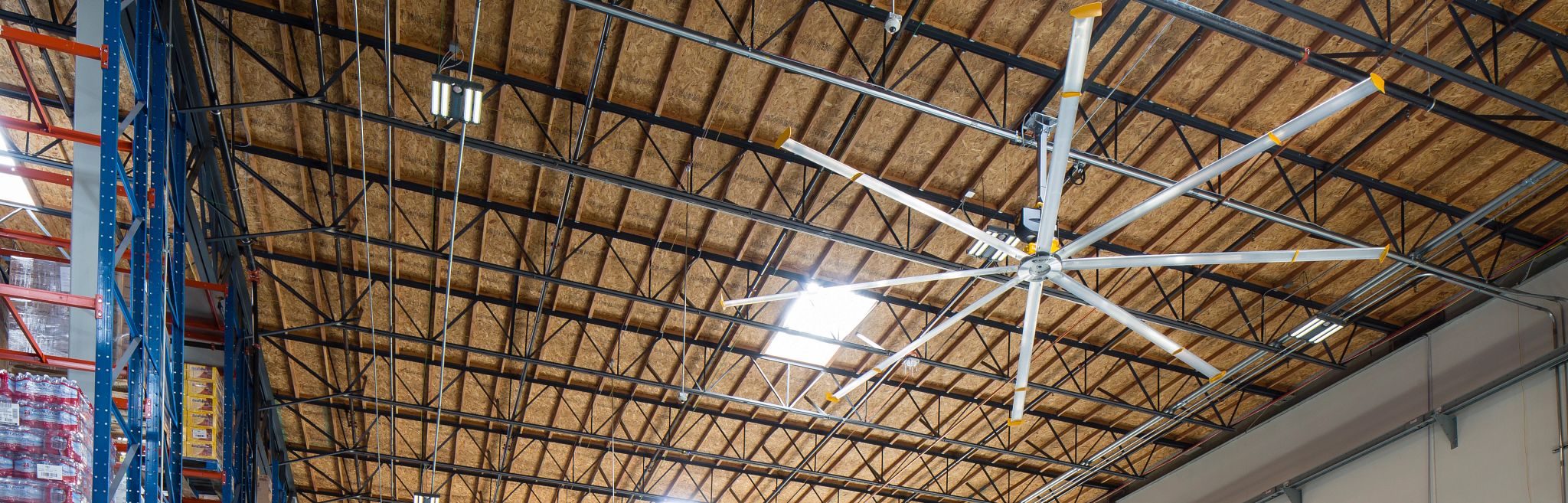
We have applications engineers who help customers apply the product correctly. For a large building, an engineer can walk the space and lay out the products, then run everything through a simulation and model all the airflows. Using Big Ass Fans’ proprietary SpecLab® CFD software, engineers build a customized 3D digital model of the facility that factors in building layout, structural obstructions, and thermal conditions to predict exact airflow patterns. One example compared an original 15-fan layout with a customized layout that focused 12 fans over the dock areas and product aisles. The original layout averaged 87 feet per minute in the dock area. The customized layout averaged 258 feet per minute. When I started, you would walk in, say “about right here” and hope. Now we can demonstrate visually and quantitatively how the fans will work before the customer installs anything.
87 fpm
Original 15-fan layout — dock area airflow
285 fpm
SpecLab-optimized 12-fan layout — same dock area
8
Redundant safety systems on the Powerfoil X4
Safety engineering matters just as much as airflow performance. When operating equipment over people and operations, safety cannot be an afterthought. It requires a complete, multi-layered approach to deliver industry-leading safety standards. Flagship models like the Powerfoil X4 feature eight redundant safety systems, such as double safety cables, patented airfoil retainers, and integrated fire relays, to ensure every component stays secure under all conditions. That same level of discipline extends to custom mounting, precise clearance standards, and smart controls. Lower purchase prices are no bargain if the equipment introduces liability or needs constant service visits that disrupt daily business.
I usually get involved when we’re solving a problem the customer can’t solve or can’t solve economically. Sometimes my job is to tell the customer we’re not the answer and point them to another product. That builds trust.
The same caution applies to any claims we make. That is why I point customers to research from Cal Berkeley, the University of Sydney and Lawrence Berkeley. When we publish our own work, we place it in peer-reviewed journals where competent people can review it critically and make sure what we’re saying is real. Properly applied fans produced a large improvement in how workers experienced the heat and how hard the work felt. The physiological measures tracked by the researchers didn’t get worse.
Every hot facility won’t need the same equipment. But “we have always worked this way” isn’t an engineering analysis. Excessive heat is an operating condition that affects people, and people affect the operation. And it’s only getting more acute. According to NOAA’s National Centers for Environmental Information, 2024 marked the warmest year for the contiguous United States since national recordkeeping began in 1895. An Environmental Protection Agency analysis of NOAA records found that average temperatures across the country have increased by 0.32°F to 0.55°F per decade since the late 1970s.
“the heat tax has been there all along, hiding in plain sight.”


